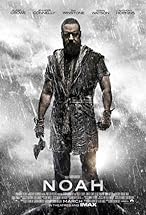
 After seeing "Noah" yesterday, here are some random observations, with a few spoilers. This film and its themes have interested me enough that I plan to further explore the idea of the flood story as one of the foundational myths of our culture, and how the film may reflect a change (or not) in our relationship to that myth.
First, most cultures have creation myths. Many also have flood stories. The Judeo-Christian culture and faith is no exception. Darren Aronofsky's "Noah" is a worthwhile telling of the period spanning the creation to the flood. Although it is based on the Judaic Genesis story, it does not follow it exactly; it is an example of a midrashic text used to explicate a biblical story. The film's notable exceptions to Genesis include the back-story, and participation in the rise of evil in the world, of the "Watchers," inspired by the Nephilim mentioned in Genesis 6. In this telling, the Watchers are fallen angels, cast out by God when they helped(?) men after the Fall. They end up assisting Noah and his family, and are thereby redeemed in the end. The screenwriters justify the Middle Earth'ian nature of this back-story and realization of the Watchers based on the fantastic nature of the pre-flood world as alluded to in Genesis (men live hundreds of years, no rainbows, etc.), which they believe gives them plenty of license.
Another notable difference is the omission of Noah's sons' wives from the occupants of the ark; the sons here are young and single. This storytelling device (as legitimate as devices used in the Genesis account) is used to develop the major conflict of the Aronofsky story, not that between Noah and the evil world, or between Noah and his family, but between Noah and the Creator (not called "God" in the film), or, some might say, between Noah and himself. While the Genesis account gives us the subserviently obedient Noah, no questions asked, thank you very much, the film has Noah wrestling with the Creator and his perceived duty. This is not the petulance of Bill Cosby's Noah, portrayed in his 1963 stand-up comedy sketch, but rather a gut wrenching emotional confrontation. Can anyone imagine buying into a Genesis-based direction from God in such an unquestioning way? That would be the way of the obsessed, the lunatic. Rather, Aronofsky shows us a Noah much more realistically accepting his duty, but then questioning it, wrestling with it, when obstacles are presented by the evil of the world, by his family, and by his own human nature, emotions, and mistakes, and Noah makes a big mistake in the film. Noah was most definitely human! It is this conflict, this transition that Noah undergoes, that makes the conclusion of the film, and of this telling of the Flood story, so satisfying.
Can you tell I really liked the story? OK, yes, but I have some lesser comments, and even a couple of nitpicky complaints.
Aronofsky depicts the pre-flood world very bleakly. It is dry, it is gray, it is not green, it is not pleasant - definitely post-Garden of Eden, which is the point and feel he is trying to convey. This strange world is generally well supported by the makeup and costumes. These are not civilized people who are leaving a comfortable home to do God's bidding. Russell Crowe (as Noah) is heavily bearded and usually dirty. Jennifer Connelly (as Noah's wife) is even more pale and gaunt than her usual self. But when they, especially Connelly, open their mouths, there are those pearly whites gleaming forth. I caught myself looking to see if one of them had accidentally left their wristwatch on during filming.
I very much appreciate the music of Clint Mansell and the Kronos Quartet. But I have to admit that there were a few times when, if I shut my eyes and imagined the visuals weren't so grungy or violent, that I might have been watching Aronofsky's "The Fountain" or even "Requiem for a Dream." A little too much film cross-talk for me. On a separate note, I enjoyed seeing that the lullaby, which plays a narrative role in the film, was written by Patti Smith (who sings it while the credits notably do not roll!) with additional credit (or perhaps it's just performance credit) given to Russell Crowe. OK, so Crowe's performance of that song is not "Les Misérables" quality, but it very much fits within the film and Crowe has already demonstrated he can at least carry a tune.
Near the end of the film, Aranofsky gets just a bit too literal and in my face conveying the notion that this problem Noah faces is one that we face today as well. That WE are the ones who by choice are destroying our world, the Creator's creation. This is not as blatant as, say, a concluding Pieta-like scene in Mel Gibson's "Passion of the Christ," where Monica Bellucci's Mary Magdalene silently calls out our guilt by lengthily staring directly at the camera, but I still thought the point was a bit crudely and too explicitly made here.
Conclusion: On a scale of five, "Noah" gets a solid four stars. Perhaps more later on myth and its value.


